

socializing knowledge
footnotes and building new worlds

I received an Instagram DM this week from an artist1 who shared his excitement about finding both Jensen McRae and Søren Kierkegaard quoted in just the first few pages of my book, Becoming Neighbors.
I love that he caught this detail.
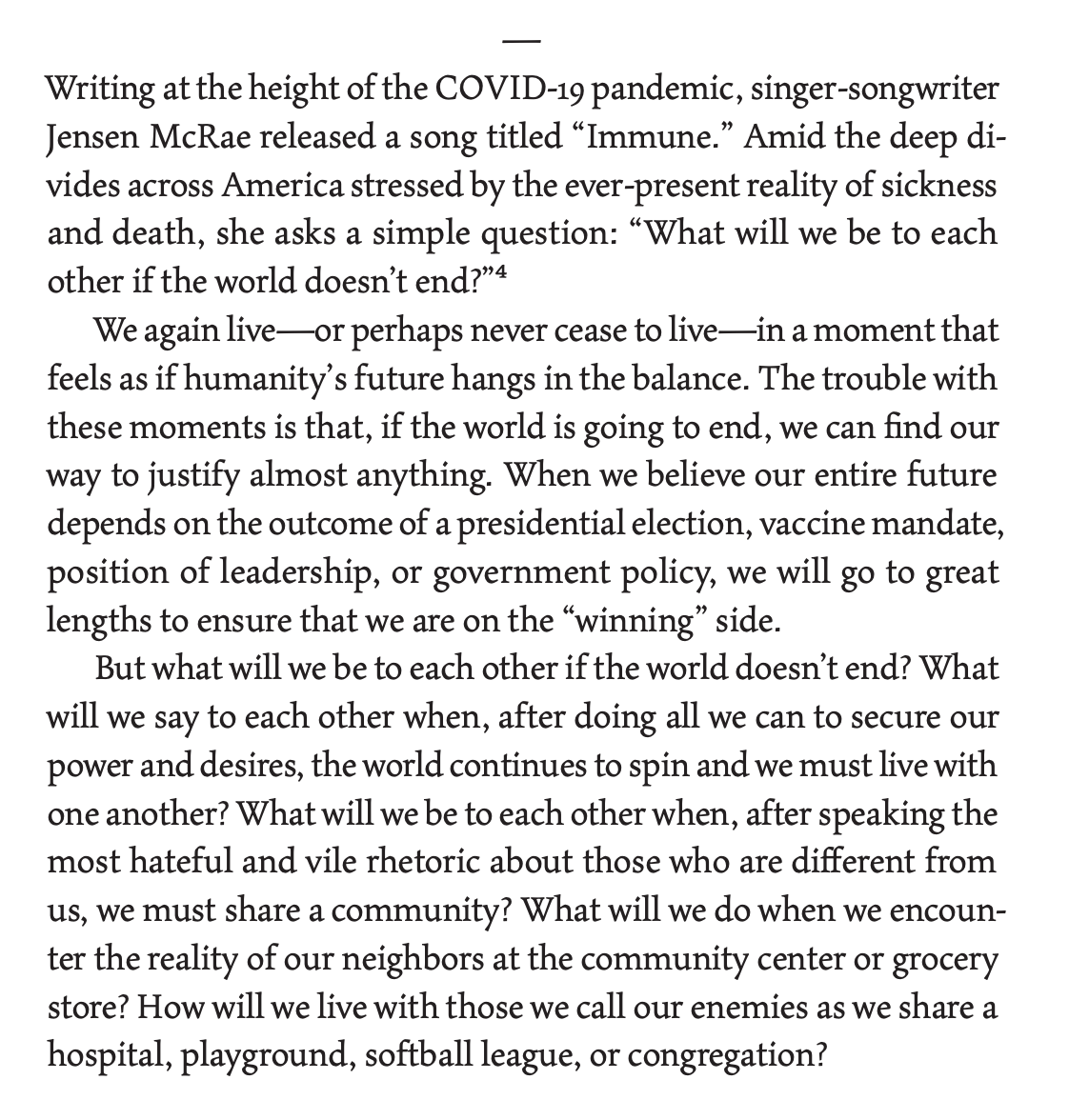
I have always been fascinated by footnotes. They tell a story that coincides with the book itself—a story of formation, of influence, of learning, of growth.
Even in my first years of college, I’d often sit in my dorm room and annotate the footnotes of my favorite readings, then go to the library to pick up the books they cited. The process continued with those books and the footnotes they held. This was world-building for me.
As an author, I’ve found footnotes to be the place where your excitement for a topic overflows. There’s only so much you can put in the text — and great editors will do even more to keep you on track. But the footnotes are where you can run free. Thoughts, musings, incomplete ideas, and background information all live there.
Because of this, I’m intentional with my footnotes and citations.
Certainly, it is good and right to name where your ideas come from. But this is more than avoiding plagiarism.
Footnotes also tell you about the people who have shaped my own imagination. When you see authors cited over and over, you can begin to piece together who I am looking to in this moment for wisdom and guidance.
At the heart of it, footnotes (and bibliographies) reveal who is really informing my ideas—who is guiding my work.2
Footnotes are also where I love to share—to “socialize”—knowledge.3
So often, the ideas of great thinkers are put behind the gates (the literal ‘pay wall’) of the academy. But I believe these thinkers have so much to offer us in making sense of the world we inhabit. They have concepts, tools, ideas, and concerns that illuminate the problems of our world today. Many are dealing with theological and existential crises that keep them up night and day as they restlessly put pen to paper, trying to make sense of things unknown—to reign in the chaos of their own minds.
This is why I find it useful to draw from Jacques Lacan to talk about MAGA and the Epstein files, Wittgenstein to make sense of Christian nationalism, and Martin Heidegger’s Being and Time to better understand Vince Gilligan’s world of PLUR1BUS.4
But these gifts are often rendered inaccessible to the broader public. They can undoubtedly be hard to understand. Great philosophers are not all great writers. Great theologians are not all great communicators.
It is a gift to be in the academy and learn from people who have studied just one of these figures for their entire career, converse about and debate these texts with peers and scholars, and engage with them through workshops and essays. But the academy (and often an older guard of scholars) has little interest in making these conversations accessible to the public. They demand monographs, not trade books; conference papers, not keynotes. The tenure process affirms this.
Selfishly, I do love academic writing and conference papers. There’s something satisfying about developing a rigorous argument and then meticulously defending it, or sitting with an absurdly difficult text until you seemingly bend it to your will, finally restraining its argument, ideas, and world to your comprehension. (Or, perhaps more accurately, your own comprehension and imagination are freed to understand the world of the text).
But I refuse to stay there.
My task—as someone with access to these classrooms, professors, and ecosystems of knowledge—is to share them with you.

This is why, if you flip through Becoming Neighbors, you will see Kierkegaard and Jensen side by side, just as Martin Heidegger is placed in conversation with Christian Wiman, and Augustine with Marianne Moore.
Where I talk about formation, you will find footnotes citing Wittgenstein and Durkheim. Where I talk about democracy, Jeff Stout and Marilynne Robinson. Where I talk about ‘the good,’ Oliver O’Donovan and W. H. Auden. Where I talk about love and accompaniment, Schleiermacher and Paul Farmer. Where I talk about resonance and being together, Hartmut Rosa and Norman Wirzba. Where I talk about a sacramental life, Kay Ryan and Fr. Aaron Damiani.
I quote the brilliant poet Rubem Alves at length and include sections from Claire Keegan’s Small Things Like These and Steinbeck’s Grapes of Wrath in chapter epigraphs. (Ah, epigraphs. I love them as much as footnotes - but that is another essay).
Dear friends, like Yanan Melo, a rising decolonial theologian, and Lauren Daniels Judge, an eco-theologian and educator, help me make sense of place and people, death and resurrection, hope and joy.
They all go together. I’m convinced of this.
You will find all of these writers, poets, song-writers, philosophers, theologians, organizers, and many more in the footnotes of Becoming Neighbors.5 I hope that, as so many writers have done for me, these musings and notes lead you on a journey that far surpasses what is contained in my short book about neighbor love and cultivating a common good.
And if it does, I would love to hear about the world you are building, too.
S/O Darek Latta! Go check out his prints on Substack and Instagram.
Certainly, there’s nuance here. Everything is collected in the bibliography. Just because you see some far-right commentators or fundamentalist theologians in my bibliography doesn’t mean they’ve positively influenced me. They are very likely being cited as a negative example. This is, in part, why I opted for footnotes instead of endnotes for Becoming Neighbors.
I first heard this language of “socializing” knowledge from Brook Wilensky-Lanford, Associate Director of Sacred Writes at a training hosted by the Christian Century’s Narrative Project. It was a passing thought but caught my attention and has stuck with me.
This essay on PLUR1BUS will be published soon in Sightings, a publication of the Martin Marty Center.
For more on these influences, see my Instagram post on the voices that inspired the book:
It's an honor to be a footnote in a super cool piece about footnotes! As a decidedly non-serious writer, this was a great read for me about the thought that goes in to those decisions.